
Two major recent announcements have me busy reading. First, CCHI released the findings of the first-ever Global Workforce Survey of Healthcare Interpreters conducted earlier this year. Over 1,400 people responded, and the data gives excellent insight into the profession with respondents from both inside and outside the U.S. and working in over 50 languages.
See the full survey report and other documents.
Second, the SAFE-AI Task Force and CoSET released their AI Interpreting Solutions Evaluation Toolkit - Part A. According to the press release, it’s “a practical, step-by-step resource built for real-world decision makers. It is the first release in a three-part series that helps teams evaluate when and how to use AI and hybrid AI-human solutions, and when to reserve interactions for qualified human interpreters.”
Download Part A of the toolkit.
These are excellent resources, and I feel I have more confidence in our future from reading them. I have some thoughts for approaching them and what I learned.
The results of the Global Workforce Survey
 For the CCHI study, I started with the Executive Summary—there is general reporting on broad categories. This helps to understand the general structure of the survey and the research goals, as well as some high-level observations. As a practicing interpreter, you’ll be able to get a good sense of your working environment as compared to others.
The actual report is substantial at 166 pages, but you can focus on key areas of concern like working environment and compensation for example. Don’t forget to look at other areas though, as so many factors are interrelated; for example, experience is a factor in compensation.
I found the appendices very interesting as there are the actual responses, as they were written. For example, when asked about reimbursement of the costs of certification, (Appendix L(3) Q. 44) 32 people responded, with one reporting: “They cover the cost for continuing ed courses and certification fees up to $500/year.”
Part A of the SAFE-AI Task Force and CoSET toolkit
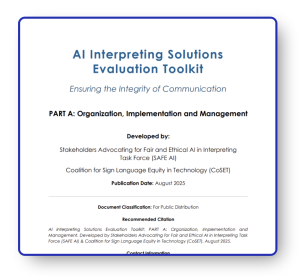 Many are very concerned about AI and fear it will take away jobs. Reading the SAFE-AI recommendations, it seems that the work will change, but it won’t go away.
The recommendations focus on three key points, or decision pillars:
- Organizational Readiness
- Technical Fitness
- Total Cost of Implementation
AI technology is certainly making advancements, but the challenges in the healthcare environment are so substantial. Patients who are incoherent, patients who have difficulty properly forming speech because of a medical condition, “reading between the lines” when a person speaks with a family member present ... The recommendations call attention to the many decisions to be made to ensure that AI actually fills the need.
One of the recommendations is to consider who in a conversation, if anyone, can ask for human intervention. A clinician may not realize that the rendition is gibberish, but does the system give the patient or family member a way to escalate? Or is it only an employee/clinician?
Looking forward to what’s ahead
I’m hopeful AI has the potential of ensuring that MORE people get the language support needed, and that trained interpreters will be monitoring service delivery and stepping in when needed. I hope that interpreters will be supportive of implementation—advocating for it when it reliably does some of the easier or boring stuff, and advocating against it when it’s not effective. History is full of technical innovations that transformed our lives—making our lives better by being better, faster, or cheaper. AI holds the same promise, but it needs to be developed and implemented—safely.
Richard Antoine, MIB/MBA
Executive Director, InterpreterEd.com